ABDM Compliant HMS
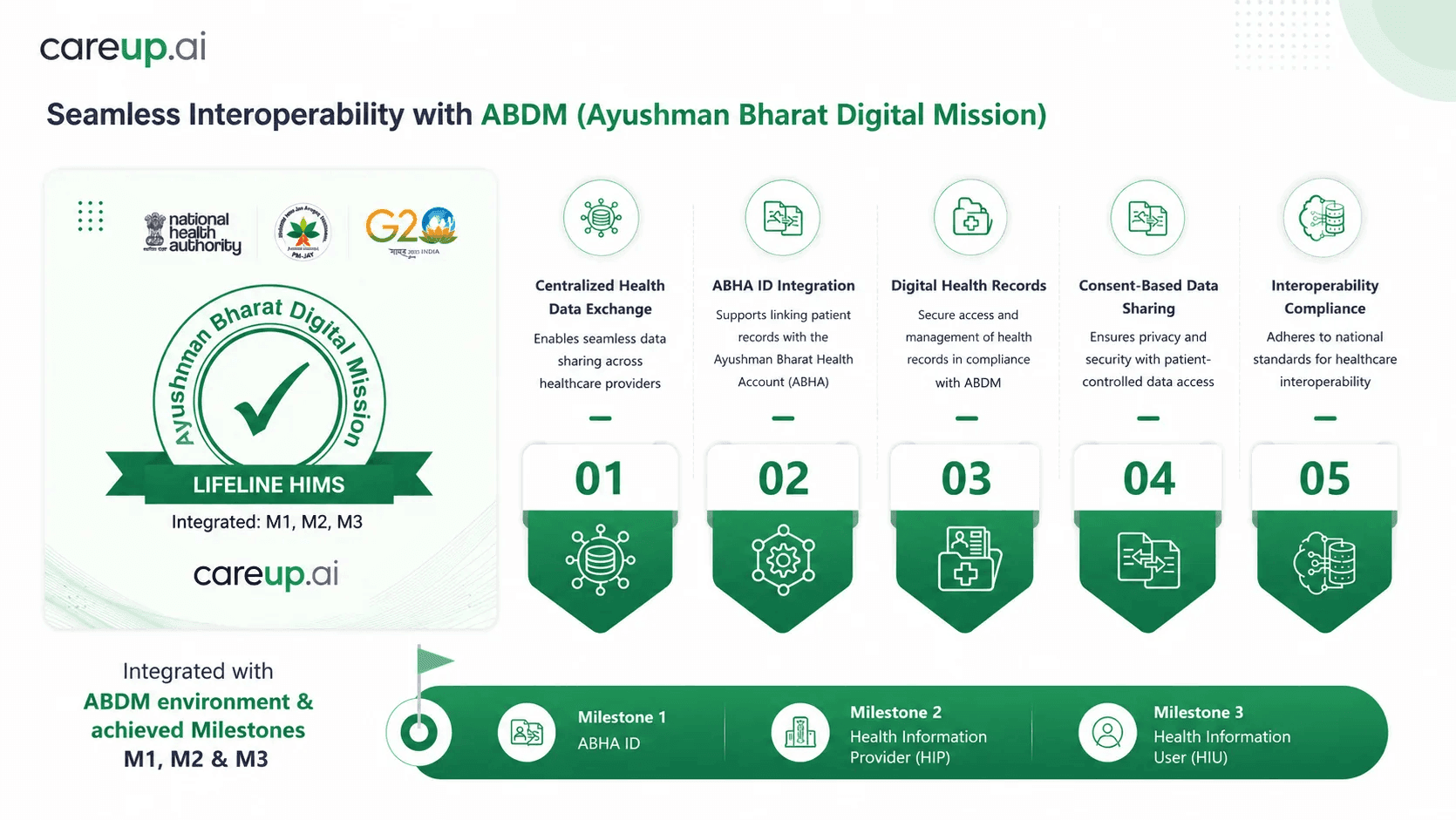
M1, M2 and M3 certified
Most vendors say “ABDM ready” without naming a single certified milestone. Here is what each milestone actually requires, what your hospital has to do that software cannot do for you, and where careup.ai is certified — and where it is not.
The Four Layers of ABDM
Three certified milestones, plus a fourth claims layer that is arriving now. Each does something specific — and a vendor should be able to tell you exactly which ones they hold.
M1 — Identity
ABHA creation, verification and patient discovery
Your system becomes an identity provider. It creates and verifies ABHA numbers at registration, discovers existing patients on the national network, and links care contexts to their health account. This is the foundation — nothing above it works without it.
M2 — HIP
Health Information Provider — sharing records out
Your system serves clinical records to the national network in HL7 FHIR R4 with India-specific profiles, only on verified patient consent, with encryption in transit and an audit trail on every disclosure. This is what stops records being locked inside your facility.
M3 — HIU
Health Information User — pulling records in
The reverse flow. Your clinicians raise a consent request for a patient's history held at any other ABDM-connected facility; once the patient approves, the records are fetched and shown alongside your own. This is where longitudinal care actually becomes possible.
NHCX — Claims
National Health Claims Exchange — sometimes called M4
A FHIR-based framework for digital insurance claims, currently required for PM-JAY empanelled hospitals and expanding into state government schemes. It is the newest layer of the stack and the one most hospitals have not yet addressed.
Certified Software Is Not the Same as a Compliant Hospital
This trips up more hospitals than any technical detail, and vendors rarely volunteer it.
Certification is per software
The vendor certifies the product once, by passing NHA's sandbox exit process. You do not repeat that certification for your hospital — you inherit it by choosing certified software. Ask any vendor for their certification status before anything else.
Registration is per facility
Every physical location registers itself in the Health Facility Registry, which issues its HIP ID and provisions the QR code patients scan to share their ABHA. Your clinicians register separately in the Health Professional Registry. Certified software does not exempt you from either.
Why This Became a Revenue Question
ABDM started as a voluntary national programme and has quietly become a commercial precondition. Empanelment under PM-JAY, participation in several state insurance schemes, and an increasing share of corporate and institutional tenders now reference ABDM participation directly. For a hospital, that moves the decision out of the IT budget and into the revenue conversation: the cost of not being compliant is no longer a missing capability, it is lost empanelment.
The confusion in the market is about what compliance actually means. ABDM certification applies to software, through the National Health Authority's sandbox exit process, and it is granted per milestone. Registration applies to your facility and your clinicians, through the Health Facility Registry and the Health Professional Registry. Certified software does not register your hospital, and a registered hospital running uncertified software is not compliant either. Both halves are required, and vendors are rarely explicit about where their responsibility ends.
This is why 'ABDM ready' is a phrase worth interrogating. It has no definition and no issuing authority. 'M1, M2 and M3 certified by the NHA' is a verifiable claim with a certificate behind it. When evaluating any HMIS for an Indian hospital, the single most useful question is which specific milestones the vendor holds, followed by asking to see the certification rather than the marketing page.
Ours, Yours, and Not Claimed
Most ABDM disappointment comes from an unstated split of responsibility. Here is ours in full, including what careup.ai is not certified for.
What Your Hospital Actually Has to Do
In order. Certified software removes the engineering from steps 3 to 6 — it does not remove steps 1 and 2.
Register the facility in HFR
Each location gets its own entry and HIP ID. Multi-site groups repeat this per site — it is not a group-level registration.
Register clinicians in HPR
Doctors and eligible healthcare professionals enrol individually. Budget time for chasing this; it is usually the slowest human step.
Enable ABHA at registration
Front-desk workflow changes: create or verify ABHA during patient registration, and handle patients who decline — consent is not optional to honour.
Turn on HIP record sharing
Map your clinical data to FHIR R4 India profiles, then link care contexts so discharge summaries, prescriptions and diagnostics become shareable.
Enable HIU retrieval
Train clinicians on raising consent requests and reading external records. The technology is the easy part; the workflow habit is not.
Assess NHCX exposure
If you are PM-JAY empanelled or working with state schemes, digital claims are becoming a requirement rather than an option. Scope it before it becomes urgent.
Typical timeline. For a 50–200 bed hospital, M1 and M2 onboarding runs 4–6 weeks, with M3 adding a further 2–4 weeks. careup.ai handles the NHA submission end to end. The step that most often slips is HPR registration — it depends on your clinicians, not your software.
ABDM Questions, Answered
What does ABDM compliant HMIS actually mean?
It means your hospital software has passed the National Health Authority's sandbox exit process for one or more ABDM milestones. M1 covers ABHA identity, M2 makes your system a Health Information Provider that shares records on consent, and M3 makes it a Health Information User that can retrieve records from other facilities. A vendor claiming to be 'ABDM ready' without naming certified milestones is claiming nothing specific — ask which milestones, and ask for the certification.
Which ABDM milestones is careup.ai certified for?
M1, M2 and M3 — all three — certified by the National Health Authority. That covers ABHA creation and verification, Health Information Provider record sharing, and Health Information User record retrieval, plus PHR app integration for patient-owned records.
Is careup.ai certified for NHCX digital claims?
No. NHCX — the National Health Claims Exchange, sometimes referred to as M4 — is not among careup.ai's published certifications. It is a newer layer that is currently required for PM-JAY empanelled hospitals and expanding into state schemes. careup.ai already runs full revenue cycle management with insurance and TPA claim workflows; if NHCX is on your roadmap, talk to us about scope rather than assuming it is covered.
How long does ABDM onboarding take?
For a mid-size hospital of 50 to 200 beds, M1 and M2 onboarding typically takes 4 to 6 weeks. M3 adds a further 2 to 4 weeks. careup.ai handles the NHA submission process end to end. The variable that most often extends the timeline is HPR registration for clinicians, which depends on your doctors rather than on software.
We already have an HMIS. Do we have to replace it to become ABDM compliant?
Not necessarily, and you should be suspicious of anyone who tells you otherwise before looking at your setup. If your current vendor is pursuing certification on a credible timeline, waiting is often cheaper than migrating. The cases where replacement genuinely makes sense are where the vendor has no certification roadmap, where the system cannot support consent-based record exchange architecturally, or where you were already planning to replace it for unrelated reasons. We will tell you which case you are in.
What is the most common reason ABDM onboarding runs late?
HPR registration. The software side is predictable — M1 and M2 typically run 4 to 6 weeks for a mid-size hospital, M3 another 2 to 4 — but every clinician has to register themselves in the Health Professional Registry, and that depends on doctors completing a process no vendor can complete on their behalf. Hospitals that start HPR registration on day one rather than at the end finish materially faster.
What happens to patients who refuse an ABHA?
They are treated exactly as before, and that has to work properly in the system rather than as an exception path that front-desk staff route around. ABDM is built on consent: a patient can decline to create an ABHA, decline to link a care context, or withdraw consent later. Your registration workflow has to handle all three without blocking care, and your records have to stay complete for patients who are not on the network at all.
Does certified software mean my hospital is automatically compliant?
No, and this is the most common misunderstanding. Certification is granted per software product; registration is per facility. Your hospital still registers in the Health Facility Registry to obtain its HIP ID and scan-and-share QR code, and your clinicians still register in the Health Professional Registry. Certified software removes the engineering work, not the registration.
What is UHI, and is it the same as ABDM?
UHI stands for Unified Health Interface. It is a component within ABDM — an open network intended to let patients discover and book health services such as teleconsultation and appointments across providers. ABDM is the overall national digital health mission; UHI is one interface inside it, distinct from the ABHA, HIP and HIU record-exchange layers that hospital software is certified against.
Go deeper
ABDM Milestone 3 (HIU) explained
The consent-request flow in detail — how records are actually fetched from other facilities.
ReadAI-first HIS for India
How ABDM workflows sit alongside AI clinical tools in an Indian hospital deployment.
ReadCompliance & certifications
ABDM, NABH, DHA, DoH, Nphies, CBAHI and JCI — the full picture across every market.
ReadWhere is your hospital on ABDM?
We will walk through your current milestone status, what HFR and HPR registration involves for your facility, and a realistic timeline — including the parts that depend on you rather than on us.