Hospital Management System
for Qatar
Qatar's Ministry of Public Health evaluates your health information system as part of facility licensing — and expects it to exchange records through QHIE-Hub. careup.ai is integrated, compliant, and already running across the GCC.
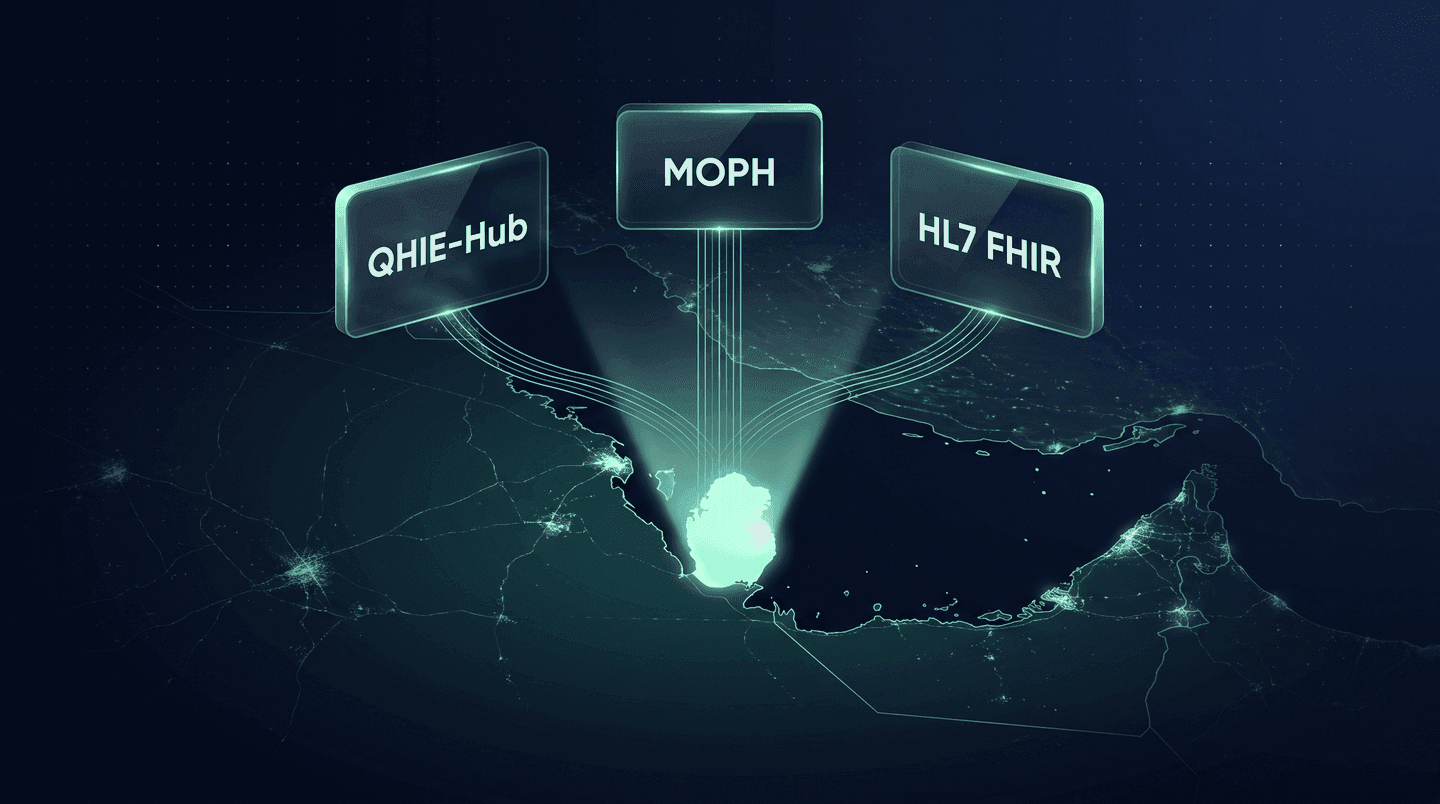
What Qatar Actually Runs
Qatar's digital health infrastructure is distinct from its neighbours'. If a vendor describes your Qatar obligations using Emirati or Saudi platform names, that is a signal worth noticing.
QHIE-Hub
Qatar Health Information Exchange Hub
MOPH's national exchange platform, connecting hospitals, clinics and pharmacies into a unified patient record. Interoperability runs on standardised HL7 and FHIR interfaces — the same class of integration as Malaffi in Abu Dhabi or Nabidh in Dubai.
QNeDP
Qatar National E-Health & Data Programme
The Ministry of Public Health's overarching framework for healthcare digitisation, setting the regulatory expectations and data standards that licensed facilities are measured against.
MOPH facility licensing
Health information system evaluation
MOPH assesses your health information system as part of facility licensing — reviewing functionality, data management practice and interoperability readiness. Your HMS is part of the licensing conversation, not separate from it.
Law No. 13 of 2016
Personal Data Privacy Protection Law
Qatar's data protection statute. Combined with MOPH guidance it requires enforced access controls, audit logging of record access, encryption of health data, and mechanisms honouring patient rights over their own records.
Six Things Your HMS Has to Handle
A practical checklist to evaluate any hospital information system against before signing in Qatar.
QHIE-Hub interoperability
Submit and retrieve patient records through the national exchange over HL7 / FHIR interfaces, rather than keeping records siloed inside your facility.
National coding and terminology standards
Clinical data has to be coded to Qatar's National Healthcare Coding and Terminology Standards so records remain machine-readable across the exchange.
Compliant e-prescribing
E-prescribing must meet MOPH standards, connect to national drug databases, and enforce Qatar-specific formulary controls at the point of prescribing.
Arabic and English clinical records
Qatar's population and clinical workforce are multilingual. Records, patient communication and printed documentation need to work in both Arabic and English.
Insurance claim workflows
Private facilities handle a mix of employer schemes, international insurers and self-pay. Pre-authorisation and claim workflows need to accommodate all three.
Auditability and access control
Every record access timestamped and attributable, granular role-based permissions, and encryption at rest and in transit — the practical requirements behind Law No. 13 of 2016.
How Qatar's Market Is Structured
Qatar runs a two-tier system. Hamad Medical Corporation operates the public hospital network and the Primary Health Care Corporation covers community and primary care, while a growing private sector serves a population that is predominantly expatriate. The Ministry of Public Health sits above all of it as the single licensing and regulatory authority — which is a meaningful structural difference from the UAE, where licensing is split between Abu Dhabi's DoH, Dubai's DHA and the federal MOHAP.
For a private facility, that single-authority structure cuts both ways. There is one set of standards to meet rather than three, and one licensing relationship to maintain — but there is also no second regulator to fall back on, and MOPH evaluates your health information system directly as part of facility licensing rather than treating IT as a separate matter.
The National Health Strategy 2024–2030 is the policy frame driving current digitisation requirements. Its practical consequence for hospital operators is that interoperability and structured electronic records have moved from competitive advantage to licensing precondition. A system that cannot exchange records through QHIE-Hub is a licensing problem, not a feature gap.
What a Qatar Deployment Involves
Five workstreams, some of them parallel. We scope the timeline per facility once we understand your specialty mix and licensing position — rather than quoting a number that fits every hospital.
Regulatory and scope assessment
We map your facility's licensing position, specialty mix and existing systems against MOPH requirements, and identify what has to change. This is where the honest scoping happens — including cases where your current system can be integrated rather than replaced.
Clinical and billing configuration
Workflows are configured to your specialty mix rather than a generic template: order sets, clinical documentation, formulary controls, and the pre-authorisation and claim workflows your payer mix requires. This is the workstream that drives most of the timeline.
Terminology and coding alignment
Clinical data is mapped to Qatar's National Healthcare Coding and Terminology Standards so records stay machine-readable across the exchange. Migrated historical data is mapped in the same pass.
QHIE-Hub connection and conformance
Your facility is connected to the national exchange: FHIR profile conformance, consent handling, and audit logging on every disclosure. Because the integration is already built and running, this is a configuration and testing exercise rather than an engineering project.
Parallel run and cutover
Clinical and billing teams run both systems in parallel over an agreed window, with reconciliation on claims and clinical documentation before cutover. Training runs in Arabic and English against your own configured workflows, not a demo environment.
What We Claim — and What We Don't
Vendors in this market routinely blur the line between integrated, planned and theoretically possible. Here is ours, stated plainly.
Five National Platforms, Four Countries
QHIE-Hub is a FHIR-based national exchange, and careup.ai is integrated with it. It is the fifth national health platform we connect to across four countries — which is the relevant question to ask any vendor bidding for your Qatar facility.
ABDM — M1, M2 and M3
IndiaCertified across all three milestones by the National Health Authority. FHIR-based record exchange into a national network.
Malaffi HIE
Abu DhabiLive integration with Abu Dhabi's health information exchange, including UMRN support.
Nabidh HIE
DubaiLive integration with Dubai Health Authority's exchange platform.
Nphies
Saudi ArabiaDirect integration for electronic claims submission, with CCHI testing handled as part of implementation.
QHIE-Hub
QatarIntegrated with Qatar's national health information exchange over HL7 FHIR, with clinical data mapped to Qatar's national coding and terminology standards.
Why this matters in Qatar: QHIE-Hub integration is not a checkbox — it is consent handling, FHIR profile conformance, terminology mapping and audit logging working together under MOPH scrutiny. We built exactly that four times before arriving in Qatar. Ask any vendor how many national exchanges they have actually connected to, and how many are live rather than planned.
Qatar Questions, Answered
Is careup.ai integrated with QHIE-Hub?
Yes. careup.ai exchanges records with Qatar's national health information exchange over HL7 FHIR, with clinical data mapped to Qatar's National Healthcare Coding and Terminology Standards, consent handling and full audit logging on every disclosure. It joins ABDM in India, Malaffi and Nabidh in the UAE, and Nphies in Saudi Arabia — five national platforms across four countries.
What does a Qatar implementation typically involve?
Three parallel workstreams: configuring clinical and billing workflows for your specialty mix, applying Qatar's national coding and terminology standards to your clinical data, and connecting your facility to QHIE-Hub. Because the exchange integration is already built, the variable is your configuration rather than our engineering. We scope the timeline per facility once we understand your specialty mix and licensing position.
Can one platform run facilities in Qatar and elsewhere in the GCC?
Yes, and this is where careup.ai is genuinely differentiated. We are integrated with QHIE-Hub in Qatar, Nabidh in Dubai, Malaffi in Abu Dhabi and Nphies in Saudi Arabia. A group operating across all four runs each facility against its own regulatory profile, from a single multi-location command centre, on one platform — not four systems stitched together.
Does careup.ai support Arabic clinical documentation?
Yes. Arabic-first clinical documentation runs in production across our GCC deployments, alongside English and additional languages. Patient-facing communication, clinical records and printed documentation all support both Arabic and English — which matters in Qatar, where the population and clinical workforce are substantially multilingual.
Can careup.ai replace Cerner, Epic or a legacy HIS in a Qatar facility?
Yes, and most GCC deployments are replacements rather than greenfield builds. The work is in data migration and parallel running, not in the platform itself: historical clinical records, open encounters and outstanding claims all have to move and reconcile. We scope migration separately from configuration so you can see what each costs. Where a facility has a system it is contractually committed to for another year or two, integrating rather than replacing is sometimes the right answer, and we will say so.
What does MOPH actually review in a health information system?
MOPH evaluates the system as part of facility licensing rather than certifying products in isolation. In practice the review covers functional coverage against your licensed scope of service, data management and retention practice, interoperability readiness for the national exchange, and access control and audit capability. We supply the technical evidence for your submission — architecture documentation, interoperability conformance and security posture — but the licensing application is the facility's, not ours.
How does careup.ai handle Qatar's multilingual patient population?
Arabic and English run as native interface languages across clinical, administrative and billing modules, with right-to-left rendering throughout rather than a translation layer bolted onto an English system. Printed patient documentation, discharge summaries and patient communication generate in either language. For Qatar's wider expatriate population, patient-facing documentation can be configured per facility beyond those two.
What happens to our data if we leave?
Your clinical data is yours and exportable in standard formats — FHIR resources for clinical records, structured exports for billing and operational data. We state this plainly because it is a fair question to ask any vendor before a multi-year commitment, and because Law No. 13 of 2016 gives patients rights over their records that a facility cannot honour if its vendor holds the data hostage.
How is patient data secured?
Zero-trust architecture with continuous authentication, AES-256 encryption at rest and in transit, granular role-based access control, and a complete timestamped audit trail on every action — which is what Law No. 13 of 2016 requires in practice. The platform is VAPT certified. Data residency arrangements are confirmed per deployment.
More on the GCC
HMS for Saudi Arabia
NPHIES integrated and CBAHI ready — the neighbouring GCC market, on the same platform.
ReadMalaffi & Nabidh HIE integration
How UAE health information exchange integration works in practice — the closest analogue to QHIE-Hub.
ReadCompliance & certifications
The full picture: ABDM, NABH, DHA, DoH, Nphies, CBAHI and JCI across every market we serve.
ReadPlanning an HMS decision in Qatar?
Our GCC team will walk through your licensing timeline, QHIE-Hub onboarding for your facility, and how careup.ai configures to your specialty mix.