The Future of HMIS:
10 Trends Shaping Hospital Information Systems
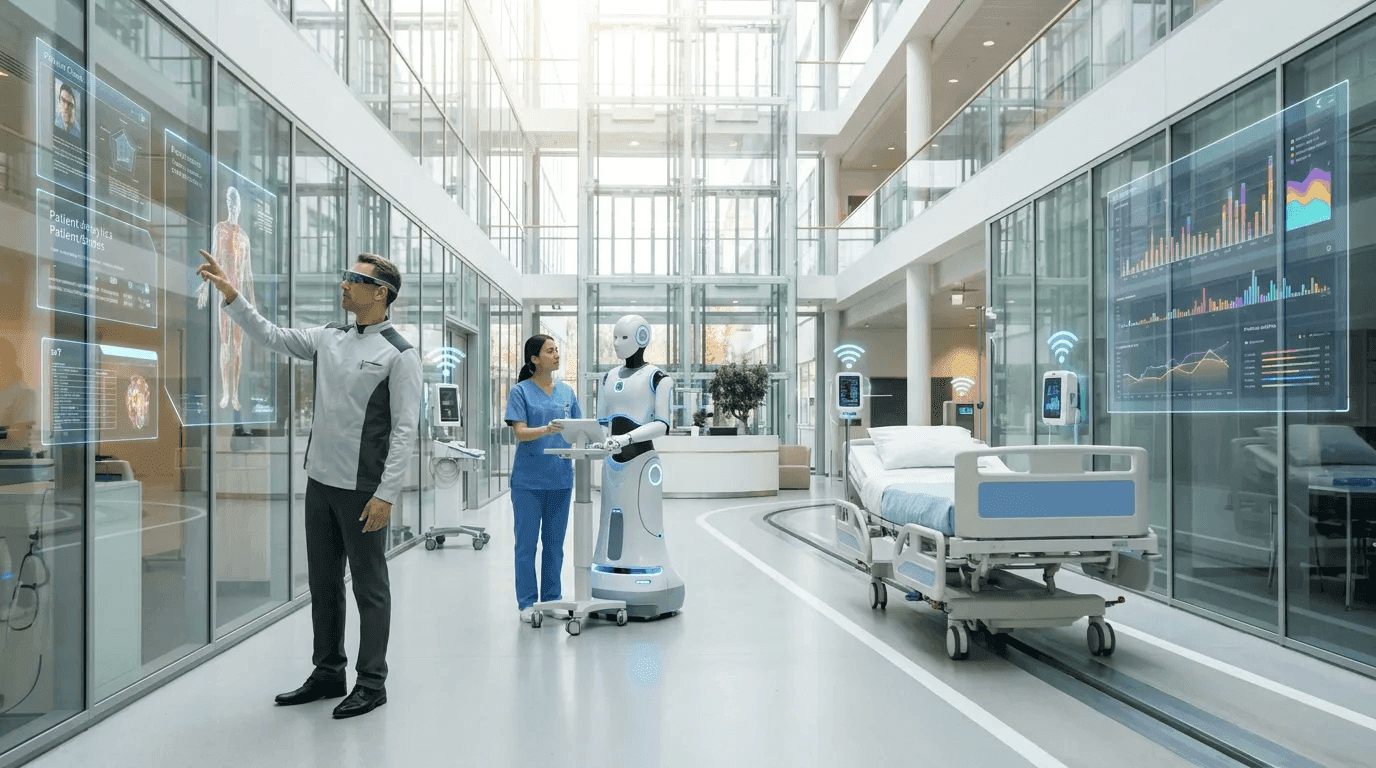
The Hospital Management Information System market is in the middle of a technology earthquake. AI, ambient computing, national health data networks, and consumer-grade patient expectations are combining to make today's HMIS obsolete at an accelerating pace. Hospital leaders who understand what's coming can position their facilities to lead.
Why the Next 5 Years Are Critical
The gap between leading-edge and lagging HMIS platforms is widening faster than at any point in healthcare IT history. AI-native platforms are achieving 60%+ documentation efficiency gains, 22% revenue improvement, and measurable clinical outcome improvements. Hospitals running 10-year-old HMIS platforms cannot compete on these metrics.
Here are the 10 trends every hospital leader must understand before their next HMIS selection or renewal decision:
10 Trends Shaping the Future of HMIS
AI Becomes the Clinical Layer
By 2027, AI will be embedded in every clinical workflow — from note generation to diagnostic support, drug safety checks, and risk stratification. The distinction between 'HMS' and 'AI clinical platform' will disappear.
Ambient Clinical Intelligence
Ambient AI will listen to doctor-patient conversations and auto-generate structured clinical notes, prescriptions, and care plans — eliminating documentation burden entirely. Early adopters are already seeing 60% documentation time savings.
National Health Data Interoperability
Every major economy is building national health data exchange platforms (ABDM in India, Nphies in Saudi, Nabidh in UAE). HMIS that cannot plug into these networks will become operationally and legally untenable.
Precision Medicine at the Point of Care
Genomic data, biomarker profiles, and personalised treatment algorithms will be delivered at the point of care through the HMS. The future EMR will include genomic risk scores alongside traditional vitals.
IoT-Integrated Patient Monitoring
Wearables, bedside monitors, infusion pumps, and imaging devices will all feed data directly into the HMS in real time. AI will analyse this continuous data stream to detect deterioration hours before clinical signs appear.
Predictive Operations and Resource Planning
AI models will predict admission demand, OR utilisation, staff requirements, and supply chain needs weeks in advance — enabling hospitals to plan proactively rather than react reactively.
Consumer-Grade Patient Experience
Patient expectations are being set by apps like Uber and Amazon. Future HMIS will feature consumer-grade patient apps with self-scheduling, digital payments, telehealth, real-time wait updates, and personalised post-care plans.
Zero-Trust Security Architecture
Healthcare remains the most targeted sector for cyber attacks. Future HMIS will operate on zero-trust principles — continuous authentication, micro-segmented networks, anomaly detection, and encrypted data at every layer.
Multi-Cloud and Edge Computing
Critical clinical applications will run on edge infrastructure within the hospital for sub-second response times, while non-critical workloads scale on public cloud. HMIS architectures will span multiple deployment models.
Autonomous Revenue Cycle Management
AI will handle the entire revenue cycle autonomously — charge capture, coding, claim submission, denial management, and collections — with humans focusing only on exception handling and strategic decisions.
What This Means for Your HMIS Selection
- → Is AI native to the platform, or added as a module afterthought?
- → Does the vendor have a credible roadmap for ambient documentation and voice?
- → Is the platform already certified for national HIE integrations in your country?
- → Can the architecture handle IoT data streams at hospital scale?
- → What is the vendor's track record of technology evolution over 5+ years?
- → Is zero-trust security the foundation, or a feature bolted on?
careup.ai: Built for the Future of HMIS Today
careup.ai was engineered with 2030 in mind. The platform already delivers on AI clinical layer, national HIE integration, consumer-grade patient app, zero-trust security, and AI revenue cycle. The product roadmap accelerates delivery on ambient documentation, precision medicine, IoT integration, and edge computing through 2026.
See tomorrow's HMS today
Book a demo to see how careup.ai already delivers on the HMIS trends of 2025–2030.
Book a Forward-Looking DemoConclusion
The future of HMIS is AI-native, ambient, interoperable, and consumer-centric. The hospitals that will lead in 2030 are those making smart platform choices today — selecting vendors not just for what they deliver now, but for the technology foundation they are building on.
Future-Ready HMS Demo
See how careup.ai already delivers on the HMIS trends shaping healthcare to 2030.
Not ready for a demo yet?
Related Articles
Future-Ready from Day One
careup.ai is built on the technology architecture that will define HMIS for the next decade.
Book Your Future-Ready HMS Demo
See AI clinical tools, ambient documentation, HIE integration, and consumer patient app — live.
Not ready for a demo yet?