Best HMS for 50–200 Bed Hospitals in India:
Complete Buyer's Guide 2025
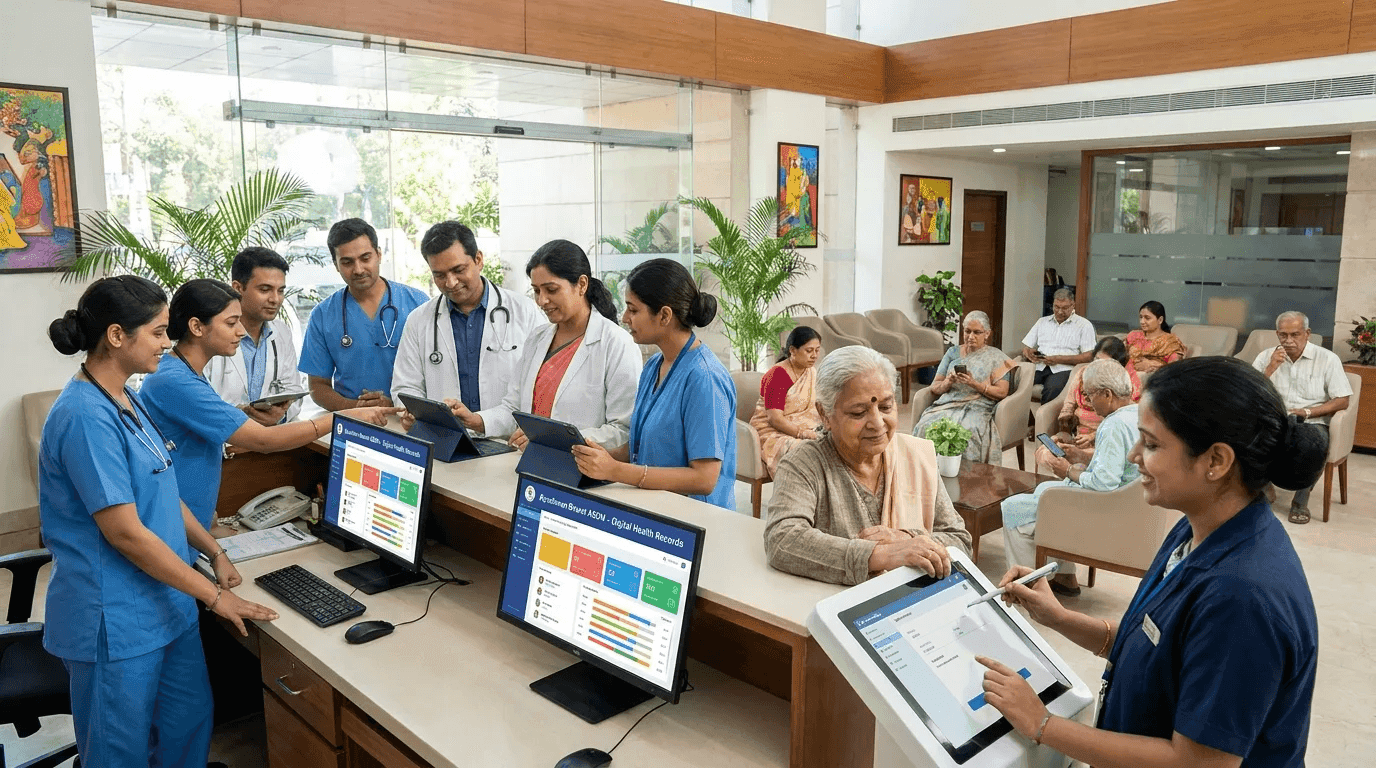
Mid-size hospitals — those operating between 50 and 200 beds — are the most underserved segment in the Indian HMS market. Enterprise systems built for 500-bed corporate chains are overkill and overpriced. Entry-level clinic software is too thin to handle the operational complexity of an inpatient facility. This leaves hundreds of district hospitals, nursing homes, and specialty centres flying blind — or stuck with legacy software that creates more problems than it solves.
This guide is written specifically for owners, CEOs, and medical directors of 50–200 bed hospitals evaluating HMS software in 2025. We cover what features actually matter, what to ignore, how ABDM compliance works, and exactly what questions to ask before signing any contract.
Why Mid-Size Hospitals Need a Different HMS
A 500-bed corporate hospital has a dedicated IT team, a CIO, and negotiating power with large vendors. A 15-bed clinic has simple needs — scheduling, billing, a basic EMR. A 100-bed hospital sits in neither camp. You have genuine clinical complexity — ICU, OT, pharmacy, lab, multiple specialties — but you don't have a 10-person IT department to manage an enterprise platform.
This creates three specific requirements that most HMS vendors are not built to address:
- → Module depth without enterprise complexity: You need proper OT scheduling, TPA billing, and pharmacy inventory — but not a 200-module ERP that requires 3 months of configuration.
- → Mid-market pricing: Enterprise HMS vendors (Epic, Oracle Health, Infor) charge per-module fees that add up to ₹40–80L per year. That's unsustainable at your revenue base. You need a platform priced for your segment.
- → Self-manageable IT: You likely have one IT executive, not a team. Your HMS must be simple enough for them to manage day-to-day without constant vendor involvement.
The right HMS for your hospital is purpose-built for this segment — not a scaled-down enterprise product, and not a scaled-up clinic tool.
8 Must-Have Features for a 50–200 Bed Hospital HMS
Integrated OPD + IPD
OPD and IPD must share a single patient record. Separate modules that don't talk to each other create duplicate data entry, billing errors, and dangerous clinical gaps. Demand tight integration — not a connector.
In-House Pharmacy & Lab
For a 50–200 bed hospital, pharmacy and lab are core revenue centres. Your HMS must handle inventory, dispensing, test orders, result entry, and direct billing from a single screen — not separate software.
Insurance & TPA Billing
TPA empanelment is essential for sustaining occupancy. Your HMS must handle cashless pre-auth requests, TPA claim submissions, CGHS/ECHS billing, and denial tracking natively — not through manual spreadsheets.
ABDM M1 / M2 / M3 Compliance
All three ABDM milestones are now mandated for hospital empanelment and government scheme participation. Your HMS must support Health Facility Registry (M1), HIMS integration for patient records (M2), and HIU for health data exchange (M3).
Operational Analytics
You need real-time dashboards for bed occupancy, revenue by department, doctor-wise productivity, pharmacy stock turns, and lab TAT. Without this, management decisions are based on guesswork.
Multi-Doctor & Shift Scheduling
A 100-bed hospital typically has 15–40 consulting and resident doctors across shifts. The HMS must handle doctor-wise OPD scheduling, duty rosters, and revenue attribution correctly.
Mobile Access for Clinicians
Doctors need to view patient notes, lab results, and prescriptions from their phones. Your HMS must have a purpose-built clinical mobile app — not just a mobile-responsive web page.
Cloud-Native Architecture
On-premise servers require a dedicated IT team, backup infrastructure, and hardware refresh cycles. A true cloud-native HMS gives a 50–200 bed hospital enterprise-grade uptime, automatic updates, and zero infrastructure overhead.
5 Features That Sound Good but Often Waste Budget
Vendors will demo these features enthusiastically. They look impressive. But for a 50–200 bed hospital, the ROI is rarely there — at least not at this stage of your digital maturity.
AI Chatbots for Patient Queries
Sounds impressive in demos. In practice, a 75-bed hospital lacks the digital patient footprint for a chatbot to add value. Staff will ignore it within weeks. Budget this only when your patient portal usage exceeds 40%.
IoT Bed Sensors Without Infrastructure
IoT patient monitoring requires reliable Wi-Fi across every ward, device procurement, and ongoing calibration. If your hospital isn't already investing in IoT infra, the HMS module will sit unused. Don't pay for it upfront.
ERP Integrations You Don't Need
Some vendors will demo SAP or Oracle ERP integration to justify pricing. A 100-bed hospital does not need SAP. A proper HMS with built-in finance, payroll, and procurement modules covers 95% of operational needs.
On-Premise Server Licensing
Vendors pushing on-premise servers are protecting a revenue model that requires you to keep paying for hardware, upgrades, and their on-site engineers. The total cost over 5 years is typically 2–3× what a SaaS HMS costs.
Per-Module Pricing Traps
Some HMS vendors quote a low base price, then charge separately for pharmacy, lab, OT, billing, insurance, and analytics. By the time you activate what you need, you're paying 4× the quoted price. Demand all-inclusive pricing upfront.
ABDM Compliance — What Mid-Size Hospitals Must Know
The Ayushman Bharat Digital Mission (ABDM) is no longer optional. ABDM compliance is increasingly required for government scheme empanelment, hospital accreditation, and operating under PM-ABHIM. There are three milestones, each building on the last:
Health Facility Registry
Register your hospital in the national Health Facility Registry. This is a prerequisite for all ABDM participation and government scheme empanelment. Your HMS must initiate and manage HFR enrollment directly.
HIMS Integration for Patient Records
Issue ABHA-linked Health IDs to every patient. Your HMS must create and link patient records to ABHA numbers at registration, and share structured discharge summaries and prescriptions with the National Health Exchange.
HIU — Health Data Exchange
Act as a Health Information User: request, fetch, and consume patient health records from other facilities via ABDM-linked consent. Critical for continuity of care and referral workflows. M3 is increasingly required for empanelment renewals.
Before evaluating any HMS vendor, confirm that all three milestones are live in their production platform — used by real hospitals — and not just in development. Ask for reference clients who are actively M3-certified.
Evaluation Checklist — 12 Questions to Ask Every Vendor
Use this list in every vendor demo and proposal review. Vendors who can't answer these confidently are not ready for your hospital.
Is the platform cloud-native (not just cloud-hosted on a VM)? What is the uptime SLA?
Are all three ABDM milestones (M1, M2, M3) live and in production — not just on the roadmap?
Can I see a live demo of the TPA billing workflow including pre-auth and denial management?
How many active hospitals in the 50–200 bed segment are using your platform today?
What does your implementation timeline look like, and how many of your staff are on-site vs. remote?
What training is included — and is retraining available when staff turn over?
What is the escalation path for P1 (system down) issues? What is your resolution SLA?
Is pricing all-inclusive, or will modules like pharmacy, lab, and analytics cost extra?
Do you charge for each additional user/doctor, or is it a flat hospital-level fee?
What does your data migration process look like, and what happens to my data if I want to leave?
Are updates automatic, or do I need to schedule downtime for upgrades?
Can you provide 3 reference contacts from hospitals of similar size who went live in the last 18 months?
Total Cost of Ownership — What to Budget
HMS pricing is rarely what it appears in the first proposal. Here is a realistic breakdown of what a 50–200 bed hospital should budget across implementation, ongoing subscription, and ancillary costs:
The most common trap is choosing the lowest-quoted subscription price, only to discover that pharmacy, lab, TPA billing, and analytics are all separate modules with their own fees. Always request a full all-modules, all-users quote before comparing vendors.
Why careup.ai Is Built for This Segment
careup.ai was designed specifically for mid-market Indian hospitals — not adapted from an enterprise product, and not a basic clinic tool scaled up. The platform ships with 30+ integrated modules covering OPD, IPD, pharmacy, lab, OT, nursing, TPA billing, payroll, and analytics — all on a single cloud-native stack.
- AI-native: Clinical documentation assistance, diagnostic decision support, and revenue cycle AI are built into the core platform — not add-on modules.
- ABDM M1/M2/M3: All three milestones are live in production, with active hospital clients certified at each level.
- Cloud-first: No servers to manage, no hardware to procure, 99.9% uptime SLA with automatic updates.
- Mid-market pricing: Flat all-inclusive pricing designed for the 50–200 bed segment — no per-module or per-user traps.
- Implementation in weeks: A typical 100-bed hospital goes live on careup.ai in 3–5 weeks, with dedicated onboarding support.
See careup.ai built for your hospital
Book a demo tailored to 50–200 bed hospitals. We'll walk through OPD/IPD, TPA billing, ABDM compliance, and your live analytics dashboard.
Book a Free DemoConclusion
The right HMS for a 50–200 bed hospital is not the cheapest, and it's not the most feature-rich. It's the one that covers your actual clinical and operational needs, is genuinely cloud-native, prices fairly for your segment, and is already ABDM-certified at all three milestones.
Use the checklist in this guide for every vendor evaluation. Ask for reference contacts from hospitals your size. Demand a full TCO breakdown before signing. And ensure that ABDM compliance is live — not promised. The hospitals making smart HMS choices in 2025 are the ones that will outperform on clinical quality, revenue cycle efficiency, and patient satisfaction through the decade ahead.
Get a Free HMS Demo
We'll show you careup.ai configured for a 50–200 bed hospital — OPD, IPD, TPA billing, and ABDM compliance live.
Not ready for a demo yet?
Related Articles
Purpose-Built for Mid-Size Hospitals
careup.ai covers every module a 50–200 bed hospital needs — at pricing built for your segment.
Book Your Free HMS Demo
Live walkthrough of OPD/IPD, pharmacy, lab, TPA billing, ABDM compliance, and analytics — tailored to your hospital size.
Not ready for a demo yet?